Monday, March 23, 2015

Get Out There!
There are different kinds of arthritis and everyone’s situation is unique. What is your story? Where have you been, where are you now with your arthritis and where do you want to go?

When did you first learn you had arthritis? What was your activity level like? Were you more active? Have you stopped doing things you enjoy because you are tired of being in pain?

Arthritis means different things to different people. What does it mean to you? Does it mean an obstacle? Is it just slowing you down or does your arthritis mean an end to a way of life for you? Does it mean you can no longer do something you love?

When you examine your situation, has arthritis become part of your self image? Has your arthritis become who you are? Does having arthritis mean you have to start acting old like your grandma or grandpa?
Active Arthritis

And what did the doctor tell you? Was your arthritis treated like a “dead-end” and did you believe it? Have you given up? Is this your just punishment for the abuse you have put on your body over the years, or did the arthritis sneak up on you like a thief in the night and rob you of your life?

Are you at peace with your decrease in activity? Are you okay with not being able to do things you used to enjoy? Is your heart telling you it is okay to live this way?


Why it matters how you think about your arthritis

The old school mentality of arthritis is itself disabling. There may be nothing that can be done to reverse the bony degeneration and break down in your arthritic joints. Often times the diagnosis of degenerative joint disease or osteoarthritis is treated like a “dead-end” because there is “nothing that can be done”  to make it go away, i.e. there is no cure per se. How many people, after reviewing the xray or MRI report have been told by the doctor they have arthritis, are given anti-inflammatory medication and told something to the effect, “..it’s just arthritis.. nothing to worry about.” End of discussion. It’s just arthritis. Maybe the sport you had to stop because of the pain, the high activity level you’ve had that is now taking a nose dive,  or the stress you’re feeling because you haven’t been able to work out and blow off steam isn’t really that big of a deal because it’s just arthritis. Gramma had arthritis. You know it really means you’re getting old. Time to start acting your age. Let the downward spiral commence…

It is common for this train of thought to lead to feelings of powerlessness since “nothing can be done.” You may have lost hope, and have true bereavement over the real loss that arthritis has caused you. 

Consider a different way to think about your arthritis and realize the truth-- that there is something that can be done. So you may be stuck with the joint break down that has already occurred-- which cannot be reversed. It is what it is. However, you can likely decrease your pain, decrease the inflammation, improve the range of motion, improve the strength of the muscles around the joint, and increase your cardiovascular conditioning. Doing all of this will increase your functionality and help you get back do doing what you want to do. In the process you have moved from a degree of dis-ablity to ability, from feeling powerless to being empowered, from inactivity to proactivity. You are in control.

Change the narrative to your story. Redefine what it means to have arthritis.

Use the means available to you. Break down your situation into the following areas and set goals:

Inflammation: There are a variety of anti-inflammatory strategies from ice, to natural supplementation, to nutritional protocols, prescription medications and even steroid injections. There is an appropriate time and place for all of these.

Joint range of motion and muscle strength: Keep moving and exercise. If you are having difficulty with daily living activities, more intense physical activity or having  a specific goal in mind,  seek out a chiropractic physician or physical or occupational therapist and stick with them until they tell you they have done everything they can for you—or until you reach a plateau and your body isn’t improving anymore.  If you aren’t happy with your doctor or therapist, get a second opinion.

Pain: Typically pain reduces relative to the inflammation and tissue healing. Subsequently, a chronically inflamed joint will be chronically painful. Pain is a funny thing, though it is no laughing manner. Everyone’s experience of pain is uniquely their own. No technology exists that can quantitatively objectify pain levels, person to person. Your pain is your own.  Learn to distinguish between you pain vs. your functionality.  Learn to distinguish between different types of pain: pain from muscle vs. pain in the joint vs. pain from a nerve.  Pain management can range from alternative medicine to medication to interventional pain management. Acupuncture is a growing field in pain management. Often times mental health / behavioral health professionals can be of particular help if your pain has been going on long enough for it to effect the way you feel about your life. Assemble your own team to help you with your pain—this could include your doctor, chiropractor or therapist.

As you regain control, define what you want to do. What is your goal? Return to a sport perhaps? Maybe it is time to find a new one? Maybe you want to simply return to your normal routine?

Remember, you are not alone. Seek out support and find other people who share your experience. There will be good days and bad days ahead and misery loves company. Call us at (630) 588-9200 and lets get you moving again!


Actve Arthritis

Wednesday, June 4, 2014


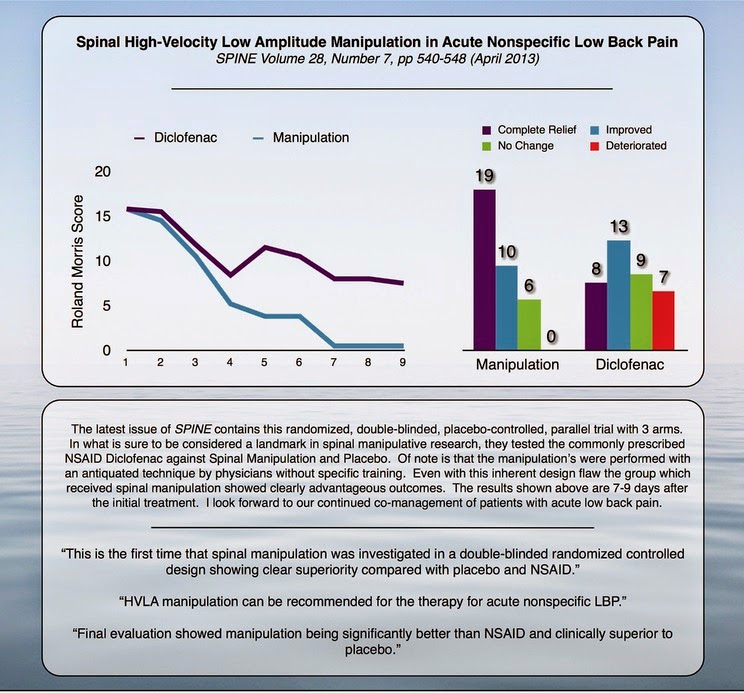
Spinal manipulation was shown to be more effective than prescription anti-inflammatory medication Diclofenac


from Evidence Based Chiropractor,Jeff Langmaid DC

Wednesday, March 12, 2014

Stephen A. Smith talks about chiropractic


"Nearly all the top professional athletes utilize chiropractic care.. it's a miracle!"

Click below to see the clip:

https://www.youtube.com/watch?v=5CQGoqkWFoo&app=desktop

Wednesday, March 5, 2014

Stop, Drop and STRETCH!

What a brutal winter we have had. The days are finally getting longer but here in the midwest there are still piles of snow. Who wants to go out in weather like this -- and it is March! Chances are, unless you are keeping up with an indoor exercise routine or playing indoor sports, you are stiffer and "tighter" than you were in the fall. Remember that connective tissue in our bodies typically stiffens with cooler temperatures. Add to this that most people have been a little more sedentary and cooped up staying indoors, except for a mad-dash from the car into a heated home, office or store.

So remember to take some extra time stretching to keep your flexibility up! If you find yourself feeling stiff, STOP, DROP and STRETCH!

Remember to continue with your home exercises daily to help you maintain the great results you made during treatment and hopefully exceed them with an even higher activity level. If you have forgotten any of the exercises and stretches, or need your home program progressed to a higher level,  please call the clinic (630) 588-9200.

Stay positive! Spring IS coming!

Monday, February 10, 2014

Acupuncture is helpful for tension type headaches

Reasearch validating acupuncture is helpful for tension type headaches

A review of 11 trials which investigated whether acupuncture is effective in the prophylaxis of tension-type headache. 

Two large trials investigating whether adding acupuncture to basic care (which usually involves only treating unbearable pain with pain killers) found that those patients who received acupuncture had fewer headaches. 

Forty-seven percent of patients receiving acupuncture reported a decrease in the number of headache days by at least 50%, compared to 16% of patients in the control groups. 

The available evidence suggests that acupuncture could be a valuable option for patients suffering from frequent tension-type headache.

From:
Cochrane Database Syst Rev. Author manuscript; available in PMC 2011 May 23.
Published in final edited form as:
PMCID: PMC3099266
NIHMSID: NIHMS284610

Acupuncture for tension-type headache

READ FULL ARTICLE HERE: http://www.ncbi.nlm.nih.gov/pmc/articles/PMC3099266/


Thursday, February 6, 2014


Neurobiological Mechanisms of Acupuncture

Evid Based Complement Alternat Med. 2013; 2013: 652457.
Published online 2013 November 28. doi:  10.1155/2013/652457
PMCID: PMC3863533

Neurobiological Mechanisms of Acupuncture

Acupuncture, an age-old healing art, has been accepted to effectively treat various diseases, particularly chronic pain and neurodegenerative diseases. Since its public acceptance and good efficacy, increasing attention has been now paid to exploring the physiological and biochemical mechanisms underlying acupuncture, particularly the brain mechanisms. Basic and clinical acupuncture studies on neurobiological mechanisms of acupuncture are crucial for the development of acupuncture. This issue compiles 32 exciting papers, most of which are very novel and excellent investigations in this field.
The neural mechanism underlying acupuncture analgesia was addressed in four articles. J. Wang et al. established a postincisional pain model of rats and investigated electroacupuncture effect on the brain oscillations involving postoperative pain. B.-S. Lim et al., using interesting bee venom acupuncture, explored whether it can relieve oxaliplatin-induced cold allodynia and which endogenous analgesic system is implicated. The paper by Yumi Maeda et al. aimed to evaluate this linkage between brain response to acupuncture and subsequent analgesia in chronic pain patients with carpal tunnel syndrome. Since many articles aimed to assess the effect of electroacupuncture induced analgesia, W. Kim et al. systemically conducted a review to assess the efficacy and clarify its mechanism on neuropathic pain. In addition, as a great challenge in acupuncture analgesia and treatment evaluations, D. Zhu et al. outlined the advantages and disadvantages of kinds of acupuncture controls and highlighted how the differences among placebo devices can be used to isolate distinct components of acupuncture treatment.
Five papers deal with potential neural mechanism underlying acupuncture treatments on the stroke, hypertension, and mild cognitive impairments. The paper by L. Liu and R.T.F. Cheung aimed to investigate whether the combination of melatonin and electroacupuncture therapies could be beneficial against transient focal cerebral ischemia in a rat model of transient middle cerebral artery occlusion. W. Qin et al. accompanied by L. Liu and R.T.F. Cheung's paper explored the importance of anti-inflammatory acupuncture treatment for the focal cerebral ischemia/reperfusion by inhibiting the NF-κB signaling pathway. Another two papers mainly focused on the acupuncture modulation of neural mechanism for hypertension regulation with long-term as well as short-term treatments. The paper by G.-H. Tian et al. addressed the long-term electroacupuncture on cerebral microvessels and neurons in CA1 region of hippocampus in spontaneously hypertensive rats. H. Chen et al. aimed to explore the hypothalamus-anchored resting brain network underlying primary hypertension patients after short-term acupuncture treatments. Moreover, for mild cognitive impairments, S. Chen et al. have pointed out that acupuncture at KI3 at different cognitive states and with varying needling depths may induce distinct reorganizations of effective connectivity of brain networks.
The neuroendocrine system involving acupuncture has been addressed by the following three papers. Z. Yu et al. has suggested that TRPV1 receptor is partially involved in the electroacupuncture-mediated modulation of gastric motility. The paper by C.-C. Kuo et al. explored the mechanism of electroacupuncture (EAc) induced antinociception involved opioid receptors and the serotonergic system. Q.-Q. Li et al. conducted a systemic review about the central mechanism of acupuncture in modulating various autonomic responses. Moreover, other papers focused on the relatively acupoint specificity from wide aspects. One of the studies by L. Li et al. suggested that both the size and function of the acupoints comply with the functionality of the internal organs; thus the sensitive degree of acupoints changed according to malfunction of internal organs. C.-Y. Chen et al. implied that somatoparasympathetic neuronal connection (groin-spinal dorsal horn-NTS/DMX-uterus) and a somatosympathetic neuronal connection (groin-spinal dorsal horn-NTS-PVN-uterus) could be the prerequisites to the neuronal basis of the somatovisceral reflex and also the neuronal mechanism of acupuncture. Z. Wang et al. advanced that the modulatory effects of different needling sensations induced by relatively different acupoints contribute to acupuncture modulations of limbic-paralimbic-neocortical network. Although the acupoints were spatially adjacent, there was also relatively functional specificity inflected by brain networks.
By gathering these papers, we hope to enrich our readers and researchers with respect to the underlying neurological mechanism of acupuncture, and we look forward to an increasing number of both clinical trials and experimental studies to further promote the development of understanding the neurological mechanism involving acupuncture.
Lijun  Bai
Richard  E.  Harris
Jian  Kong
Lixing  Lao
Vitaly  Napadow
Baixiao  Zhao

    Articles from Evidence-based Complementary and Alternative Medicine